



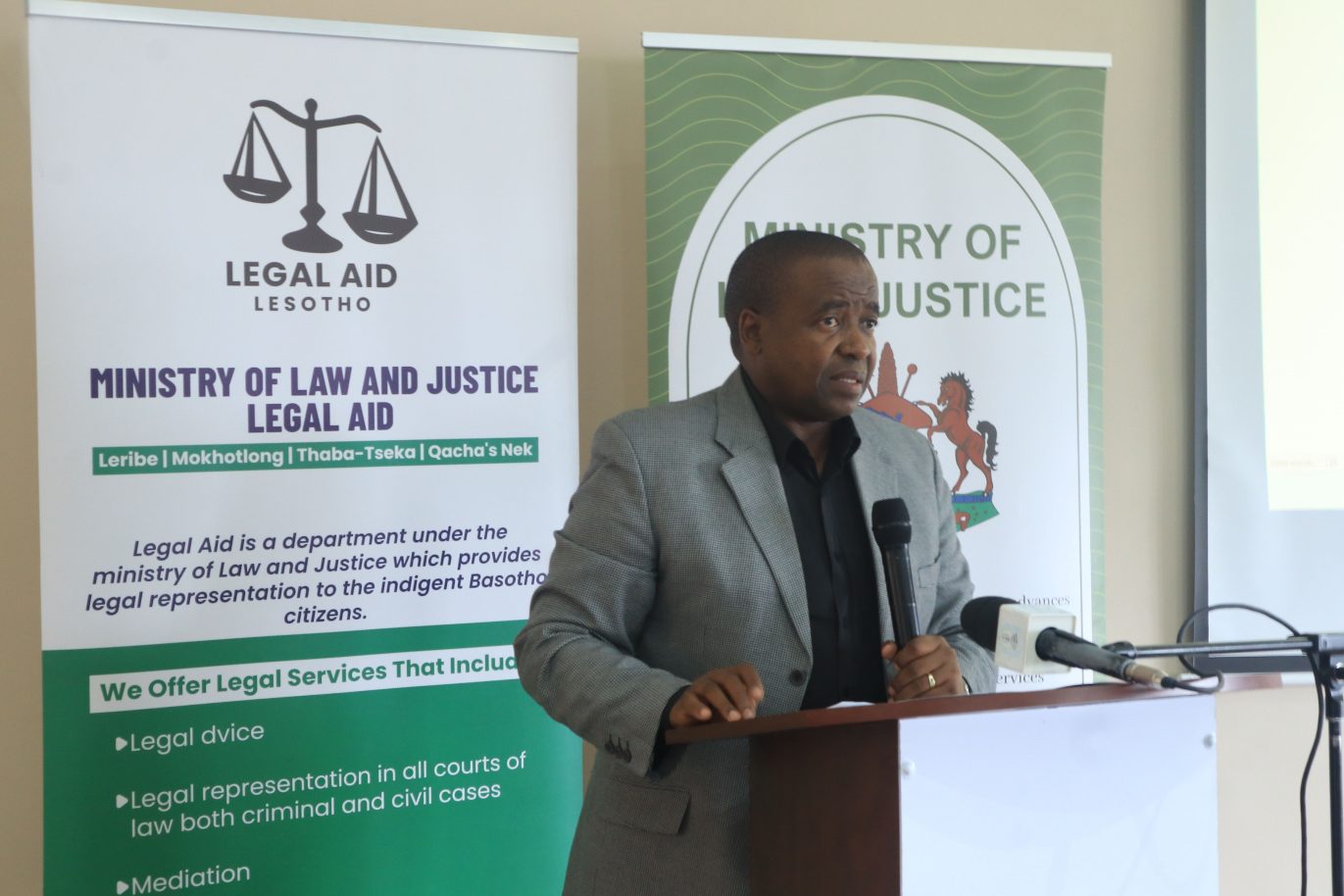
The Ministry of Law and Justice has today validated the Guidelines for Legal Aid Clinics, a major national effort aimed at ensuring equal, affordable and standardised access to justice for indigent, vulnerable and marginalised Basotho. The new guidelines establish a uniform framework for all legal aid clinics in the country and will support the operation of newly decentralised clinics in Leribe, Mokhotlong, Thaba-Tseka and Qacha’s Nek. These reforms come as Lesotho strengthens its commitment to constitutional rights, particularly the right to a fair trial as provided for in sections 12, 18 and 19 of the Constitution.
A key development under this initiative is the opening of new facilities in the highlands. On 16 December 2025, the Ministry will officially launch the Mokhotlong Legal Aid Clinic together with the Children’s Court, an achievement made possible with support from the European Union Delegation to Lesotho. This expansion follows the recent decentralisation of Legal Aid services, which previously operated only from Maseru but now include four additional district offices.
According to the Principal Secretary, Mr Lira Ralebese, all four new offices—Leribe, Mokhotlong, Thaba-Tseka and Qacha’s Nek—are already functioning and providing legal services. He noted that although the process was demanding, it represents a significant milestone in fulfilling Lesotho’s international obligations to make access to justice meaningful and universal. The first official launch of these decentralised offices will take place in Thaba-Tseka on 27 November 2025.
The Guidelines for Legal Aid Clinics have been developed in response to findings from a recent nationwide mapping exercise, which identified 56 legal aid service providers operating under different systems and approaches. This inconsistency has resulted in unequal service delivery. To address these disparities, the Legal Aid Unit in the Ministry of Law and Justice, with EU support, developed the new guidelines to standardise and harmonise legal aid services across the country. These guidelines introduce regulation, quality control, monitoring and evaluation mechanisms to ensure that legal aid providers offer services that are affordable, accessible, compassionate and professional.
The guidelines apply to all legal aid clinics, whether operated by government or civil society organisations. Relebohile Thuhlo of Women and Law in Southern Africa explained that the guidelines will be used across all legal aid providers and emphasised the importance of consistent monitoring and evaluation to ensure compliance. The clinics will offer a wide range of services, including legal advice in civil, criminal, family and administrative matters; free or affordable legal assistance for individuals who cannot afford private lawyers; legal literacy programs to improve knowledge of rights and procedures; community outreach to raise legal awareness; and the promotion of alternative dispute resolution mechanisms such as mediation and conciliation.
The Office of Legal Aid, established in 1978, has historically provided legal representation, mediation, legal advice, and assistance with contracts and deed transfers to indigent Basotho. The validation of the new guidelines marks a strengthened and modernised approach to this long-standing mandate. By standardising service delivery and extending legal aid to remote districts, the Ministry reinforces its commitment to ensuring that every Mosotho has meaningful access to justice and to building a fairer and more equitable society for all.
