
Each morning, Judge Itumeleng Shale climbs more than sixty steps to reach her courtroom. For her, those stairs are more than a daily routine—they are a physical reminder that even within institutions built to deliver fairness, justice itself can be out of reach, especially for persons with disabilities.
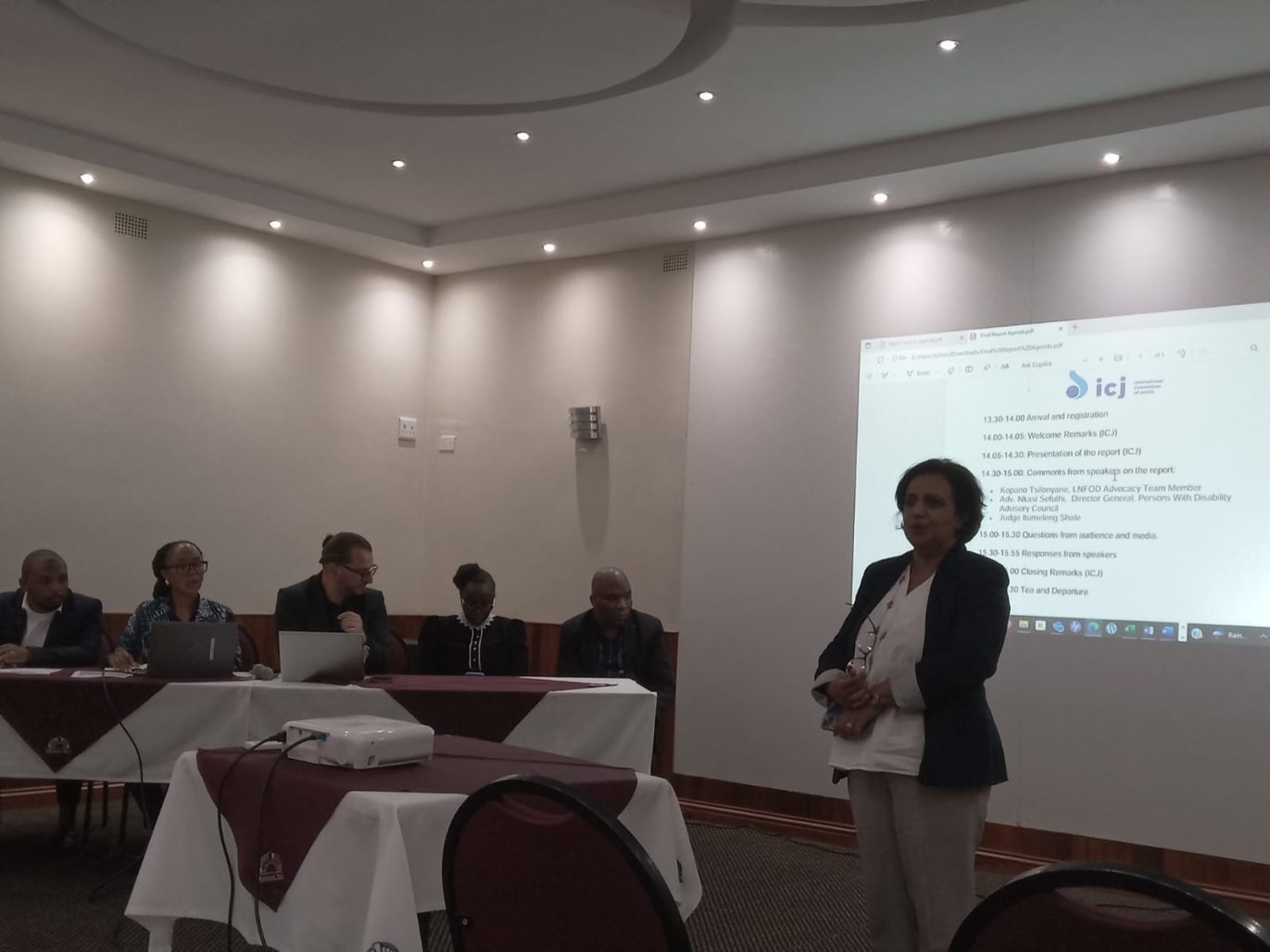
That reality lies at the heart of a new report launched by the International Commission of Jurists (ICJ) in Maseru today, titled “From Exclusion to Equality: Advancing Access to Justice for Persons with Disabilities in Lesotho.” The report offers one of the most comprehensive assessments yet of how outdated laws, inaccessible infrastructure, and the absence of reasonable accommodations continue to deny persons with disabilities their right to justice.
For decades, people with disabilities in Lesotho have endured systemic discrimination in their pursuit of justice. The ICJ notes that many court buildings remain physically inaccessible, while legal provisions still contain discriminatory language. People with intellectual or psychosocial disabilities are often denied the right to testify or participate fully in legal proceedings. Speaking during the report launch, Her Ladyship Judge Shale described how these challenges persist even at the highest levels of the judiciary.
“I work where I walk over 60 staircases to the court. Physical inaccessibility remains one of the critical challenges,” she said. “Sometimes I wait for witnesses who are elderly or have disabilities, taking over 30 minutes to reach the courtroom.” She pointed to the example of the Tšifa-li-mali Court, the Northern Division of the High Court in Leribe, which cost about M114 million to build and was officially opened in May 2022—yet its elevator has never worked. “Courts are the last resort of the people,” she added. “They must therefore be enabling and inclusive.”
The ICJ’s Africa Programme Director, Kaajal Ramjathan-Keogh, said that despite significant legislative progress, several discriminatory provisions remain embedded in Lesotho’s justice system. “Courts can still declare persons with intellectual or psychosocial disabilities ‘insane’ or ‘mentally incapacitated,’” she explained. “This often leads to forced institutionalisation or indefinite detention, which is devastating for the individuals affected.”
She acknowledged that the Persons with Disability Equity Act of 2021 and the Disability and Equity (Procedure) Rules of 2023 represent steps forward but cautioned that key gaps remain. “Authorities missed an opportunity to repeal or reform all of these discriminatory provisions when drafting the Act and the Rules. These omissions must now be corrected through new legislative initiatives.”
The ICJ report commends Lesotho for introducing a new legal framework to promote equality but stresses that implementation is the real test. It argues that access to justice requires more than laws on paper—it depends on training police, prosecutors, and judges to apply reasonable accommodations consistently. It calls for urgent reforms to eliminate discriminatory legal provisions, ensure all courts and police stations are physically accessible, and provide sign language interpretation and simplified formats for persons with intellectual disabilities. It further recommends strengthening legal aid services so that disability does not become a barrier to representation.
One of the report’s key references is the landmark case of Koali Moshoeshoe vs Director of Public Prosecutions, which changed the country’s approach to disability and justice. In August 2016, Moshoeshoe, an adult with an intellectual disability, reported being sexually assaulted by a woman. The prosecution refused to proceed, arguing that he was “incompetent” to testify under Section 219 of the Criminal Procedure and Evidence Act of 1981, which referred to persons with disabilities as “idiots” or “lunatics.”
The case sparked a constitutional challenge supported by the Lesotho Society of Mentally Handicapped Persons and Families and the Lesotho National Federation of Organisations of the Disabled. The Constitutional Court declared Section 219 unconstitutional, ruling that it violated the right to equality and freedom from discrimination. This landmark judgment opened the door for persons with intellectual or psychosocial disabilities to testify in court on an equal basis with others.
Following this ruling, Lesotho enacted the Persons with Disability Equity Act (2021) and the Disability and Equity (Procedure) Rules (2023) to put these principles into practice. The Independent Democratic Association of Lesotho (IDAL), which supported Moshoeshoe’s case, reports that more than 30 similar cases have since emerged, with about half already resolved. Yet many incidents remain unreported due to financial and social barriers, and the persistent fear among people with disabilities that their voices will not be heard.
Advocate Sefuthi, Director-General for Persons with Disabilities, welcomed the ICJ report, saying it will strengthen the work of the newly established Persons with Disability Advisory Council. “The findings provide research-based evidence that will guide our work in advising government and handling complaints,” he said. “It also helps us address unreported cases, because people with disabilities often fear not being heard and end up not reporting.”
The release of the ICJ report comes as Lesotho makes broader legislative progress. The 10th Amendment to the Constitution now officially recognises sign language, a historic step toward inclusion and equality for persons with disabilities. However, as the ICJ cautions, existing barriers—both physical and structural—must still be removed for justice to be truly accessible.
“Inclusion is not a favour,” reads one of the report’s closing lines. “It is a right.”
